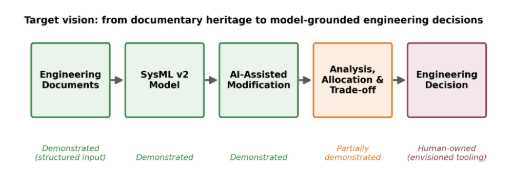
Model-Based Systems Engineering (MBSE) promises a single, consistent source of truth across the engineering lifecycle, yet its adoption at scale remains limited because contributing correctly to a system model requires an engineer to combine domain expertise, systems-engineering methodology, and modeling-tool proficiency at once. Large language models (LLMs) are increasingly explored to lower this barrier by generating SysML v2 content from natural language, but most existing approaches leave the model largely free to interpret a prompt and check correctness only after generation. This paper presents a guided-AI approach in which generation is constrained by an explicit, human-authored methodology container, and executed through a five-step agentic iterative loop with human confirmation. The approach couples a general-purpose LLM with a live SysML v2 model repository through a Model Context Protocol (MCP) server. We situate the approach within a broader target vision spanning document ingestion, AI-assisted model modification, and trade-off analysis. A preliminary, qualitative demonstration is reported on an agricultural-spraying unmanned aerial vehicle (UAV) case, including informal practitioner feedback. We discuss current limitations, distinguish explicitly between what is demonstrated and what remains prospective.
AINovember 20263 min read
Guided Artificial Intelligence for Model-Based Systems Engineering through SysML v2
This article has been submitted and is currently under review for the AFIS–IEEE 2027 Workshop. The full paper will be available soon. More articles on AI and MBSE are coming soon!
José Lameh
Head of R&D · Samares Engineering
José is an industrial and complex systems engineer with solid expertise in product line engineering (PLE). He holds a doctorate focused on PLE for systems engineering. His background combines both academic and industrial contexts, combining teaching and R&D activities with practical experience in methodological development and field deployment. He has actively contributed to the deployment of PLE practices, helping organisations to structure and optimise their engineering approaches, with experience covering both the education and automotive sectors.