
In the first set of articles, this series explains how to use a modeling approach based on the SysML notation to progressively analyze, structure, refine and derive stakeholder needs and requirements into system architecture and lower-level requirements, down to configuration items containing software and hardware parts.
In the second set of articles, this series will focus on the links to other modeling languages used to detail the design and/or perform detailed analysis and simulations to evaluate, verify or validate the virtual representation of the system.
Functional requirements and functions
- The “Block” concept is enough if we are only focused on the structural decomposition of the functions (also called functional breakdown)
- The “Activity” concept is well adapted if we want to use the behavior to identify and decompose the functions
- A combination of both a block and a behavior definition concept (state machine, activity, opaque function ) is useful when we want to have the flexibility to specify the function and its behavior separately.
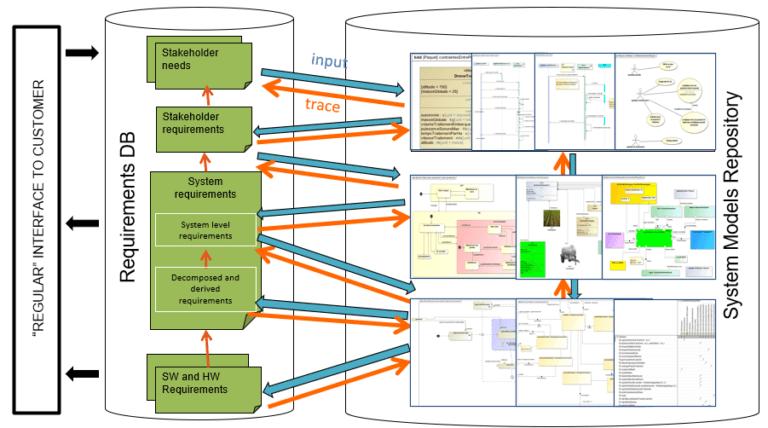
RM tool and SysML Modeling tool – How can we ensure synchronization?
Note: The derivation of requirements from a function is an advanced topic that requires some explanation. Here we show the derivation of only ONE basic (draft) requirement for simplification but a function generally leads to the identification of several requirements, built from the combination of function performance criteria and lifecycle “situation” (phase/mode/state… and conditions) in which the function is active. And each of the identified requirements will later be completed to prepare its verification, leading to an improvement of the requirement maturity and quality.
The derivation of requirements will be detailed in a future dedicated article.
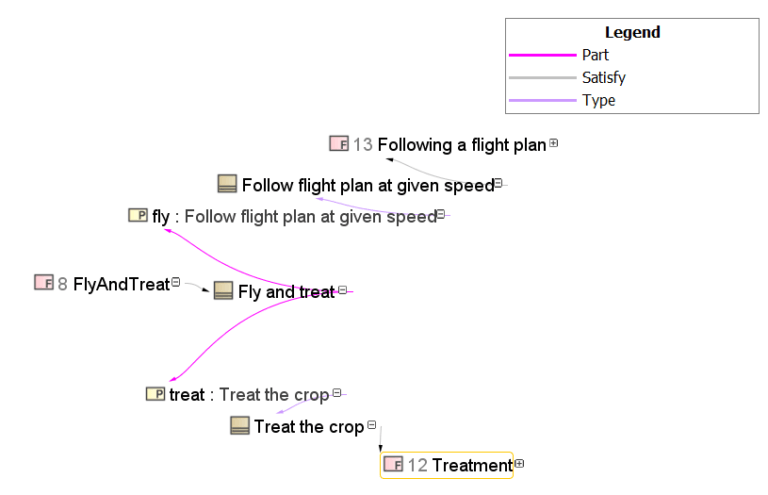
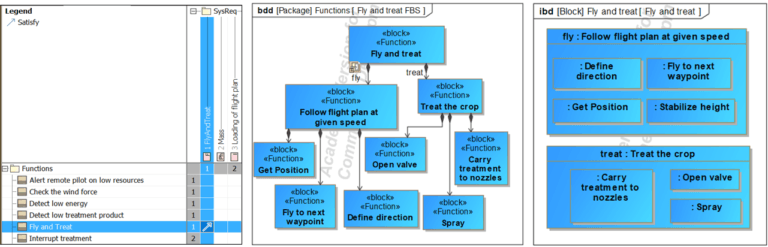
Note: the relation map can be read through the following sequence of relations: the top-level functional requirement (FlyAndTreat) is satisfied by a Function (Block) that is composed of the two sub-functions fly and treat (part properties) that are each typed (defined) by a function (block) that satisfies requirements.
- The top-level functional requirements are defined and maintained in the RM tool and propagated in the modeling tool
- The lower-level functional requirements are defined and maintained in the modeling tool and propagated later in the RM tool
This approach makes things clear by using only ONE requirement repository at a given stage. It allows an efficient definition of the requirements by using different tools according to each stage.
- Before the SRR (Systems Requirements Review): the RM tool is used to define and document all top-level system requirements
- During the elaboration of the functional architecture: the modeling tool is used to define and document lower-level (refined) functional requirements derived from the functions. This stage ends with the preparation of the Preliminary Design Review (PDR).
- Since the preparation of the PDR: the RM tool is used to gather all system requirements including the ones coming from the functional model in order to ease the review of all system requirements and to generate the complete system specification.
Can we automate the transfer of requirements between tools?
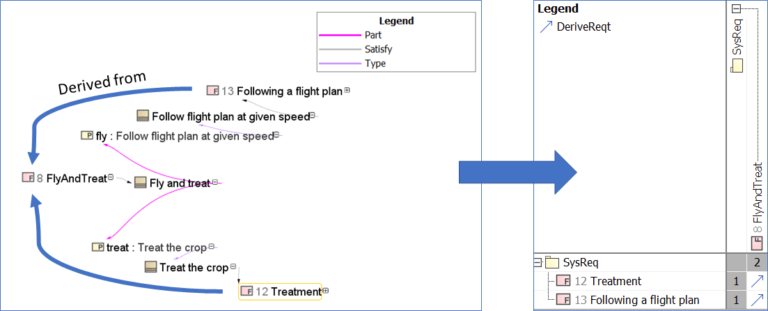
Zig zag with synchronization and automation in practice (video)
Note: the derivation of lower-level requirements is very basic in this video (as it was not the main topic and we did not want to spend time on it). There will be additional material on this topic at a later date.